


Procedures
The basis of ulcerative colitis treatment is medical, and fewer people with Colitis now require surgery than 20 years ago. Around 7 out of 100 people with Colitis will need major surgery within the first five years after their diagnosis, while roughly 10 in 100 will need major surgery in 10 years after diagnosis.1
You may be offered surgery if medicines are not helping to control your symptoms, or if you develop severe complications. Surgery is an effective treatment option for many people with UC.
Many of the common UC surgeries can be done through “keyhole” or laparoscopic surgery, meaning that they will involve smaller cuts, rather than one large one. A very small camera (plus a light and surgical tools) will be passed through these cuts.
Although keyhole surgeries usually take longer to complete than open surgeries, there are many benefits. Being less invasive, keyhole surgeries mean smaller scars and less pain after the operation, as well as lowering the risk of wound infection or hernia. They also enable a quicker recovery, all of which means you will stay in hospital for a shorter period of time. For women, keyhole surgeries also offer better fertility outcomes.
However, keyhole surgery is not always an option. Open surgery is a more traditional method, with a larger cut allowing the surgeon to see into your bowels without use of a camera. These surgeries are done under general anaesthetic, so you would be asleep and would not feel any pain.
Common surgeries include ileostomy (stoma) surgery, and pouch surgery.
Stoma
A stoma is an opening in the wall of your stomach, which moves your bowel to the outside of your body. The contents of your bowel (your stoma output) empty straight into a bag known as a stoma bag. Stoma surgery is usually required if you have had large sections of your bowel removed in surgery.
People with UC have ileostomies, which means that the stomas are made from a section of your small bowel known as the ileum. Stomas may be temporary or permanent.
Subtotal colectomy with ileostomy

Surgeon removes colon but leaves the rectum, and makes an ileostomy by joining a section of the small bowel to the surface of the abdomen. This can be temporary or permanent.
Proctocolectomy with ileostomy
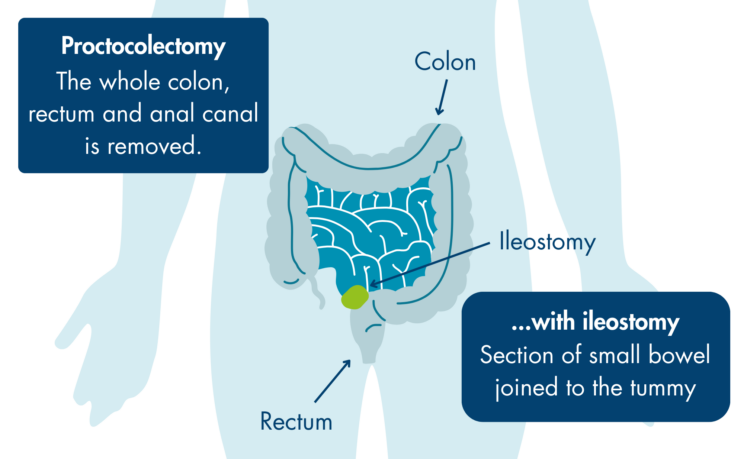
The whole colon, rectum and anal canal is removed, with the ileostomy made by joining a section of the small bowel to the surface of the abdomen. This surgery is irreversible, so the ileostomy is permanent.
Pouch surgery
Restorative proctocolectomy with ileo-anal pouch
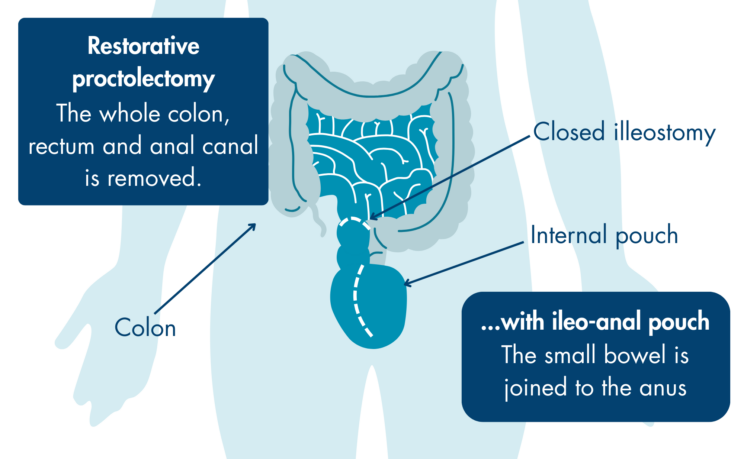
The colon and rectum are removed, with the small bowel joined to the anus. A pouch is made from the small bowel which can store poo until you are ready to go to the toilet.
This type of surgery is usually done in stages, meaning more than one surgery.
Colectomy with ileo-rectal anastomosis
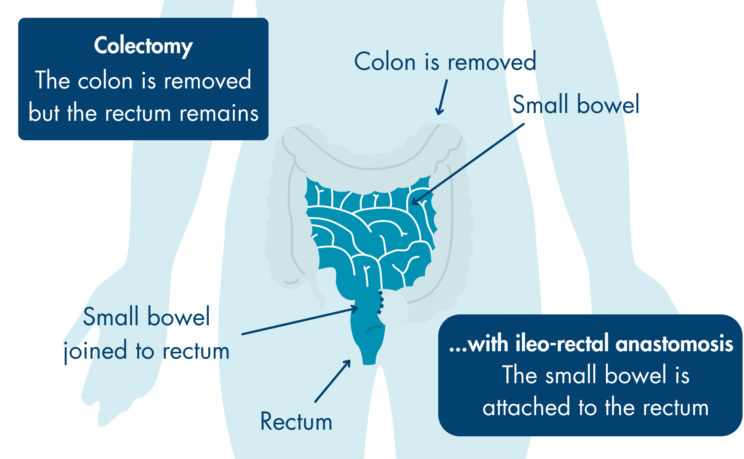
This surgery means that your colon is removed, with the end of the small bowel attached to the rectum, meaning that you can poo from your bottom and do not need to have a stoma.
References
- Crohn’s and Colitis UK – Surgery for Ulcerative Colitis. Available at: https://crohnsandcolitis.org.uk/info-support/information-about-crohns-and-colitis/all-information-about-crohns-and-colitis/surgery-and-complications/surgery-for-ulcerative-colitis. Last accessed April 2025.