


What causes UC?
Ulcerative colitis is believed to be an autoimmune condition. Your immune system is your body’s defence against infection. Normally, your immune system is capable of distinguishing between potentially harmful germs and other cells within your own body. However, if you have an autoimmune condition, the immune system becomes confused and attacks your own healthy tissues.
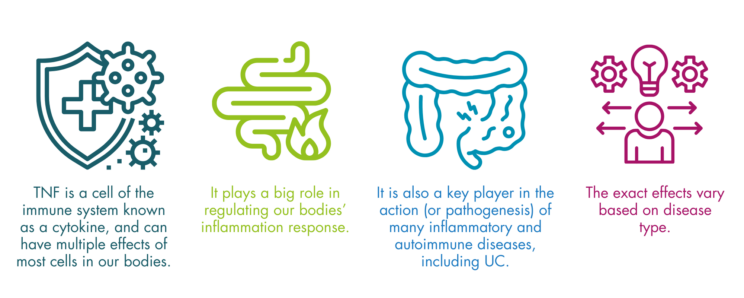
The most popular theory as to why this happens in ulcerative colitis is that your immune system mistakes harmless bacteria within the colon as a threat and attacks the tissues in the colon. The immune system releases an enzyme called TNF-alpha, along with other cells. See the diagram below for an explanation of TNF-alpha.
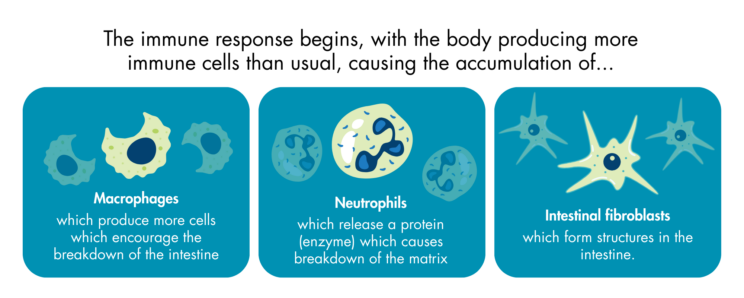
The release of TNF begins an immune response. This leads to the accumulation of yet more cells, as explained below.1
This causes the colon to become inflamed. Experts are unsure exactly what causes the immune system to behave in this way, although many experts believe that it is a result of both genetic and environmental factors.
References
- I. Ordás, L. Eckmann, M. Talamini, D. C. Baumgart, W. J. Sandborn. Ulcerative colitis: seminar. The Lancet. 2012;308(9853)1606-1619.