

Surgery for acromegaly
Having surgery to remove the tumour, or as much as possible, is often the first step in treating acromegaly.1
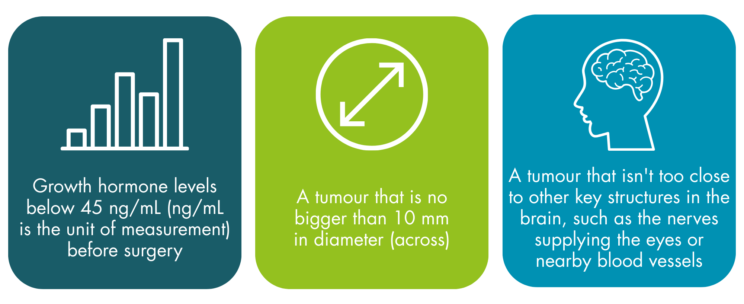
There are several things that will increase the chance of success of surgery:1
However, if your tumour is too large to be completely removed, you may still have surgery to improve your symptoms. Reducing the size of the tumour can reduce the amount of growth hormone being released, relieve pressure that may be causing headaches1 and make sure the tumour and surrounding area are suitable for treatment with radiotherapy.2
How is acromegaly surgery performed?
The pituitary gland is very small and sits at the base of the brain, in the middle of your skull. To reach it, the surgeon doesn’t have to go through the skull, but can make a small cut in the back of your nose.3 Special instruments are then used to remove the tumour. The whole operation should take about an hour and a half.3

If all of the tumour has been removed, you may begin to see improvement in your symptoms in only a few days, including changes in your facial features.3 However, sometimes, even if the levels of growth hormone released by the tumour have been reduced, you may need to have additional treatment with drug therapy.3
Having any type of surgery has some risks, and may lead to complications. Your surgeon will explain the risks of surgery to you beforehand.
References
- Health Central. What to Know About Acromegaly Surgery. Available at: https://www.healthcentral.com/condition/acromegaly/acromegaly-surgery. Last accessed April 2025.
- Bollerslev J et al. Individualised management of acromegaly. Eur J Endocin. 2019;181:R1-R15.
- The Pituitary Foundation. Treatment of Acromegaly. Available at: https://www.pituitary.org.uk/information/acromegaly-treatment/. Last accessed April 2025.