

Testing
Diagnosing acromegaly involves a combination of factors: observing physical changes, testing hormone levels in your blood, and checking the location and size of a tumour.1
To accurately diagnose acromegaly, there are two hormones in your body that need to be measured:1
- Growth hormone
- Insulin-like growth factor-1 (IGF-1).
Measuring growth hormone – oral glucose tolerance test (OGTT)
Your body does not produce growth hormone at a steady rate throughout the day. Instead, there are 6-10 ‘spurts’, with the largest release happening not long after you fall asleep.
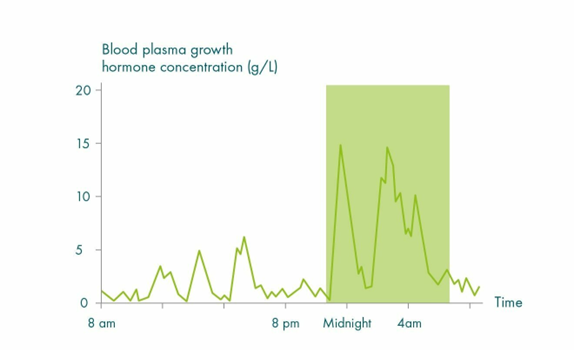
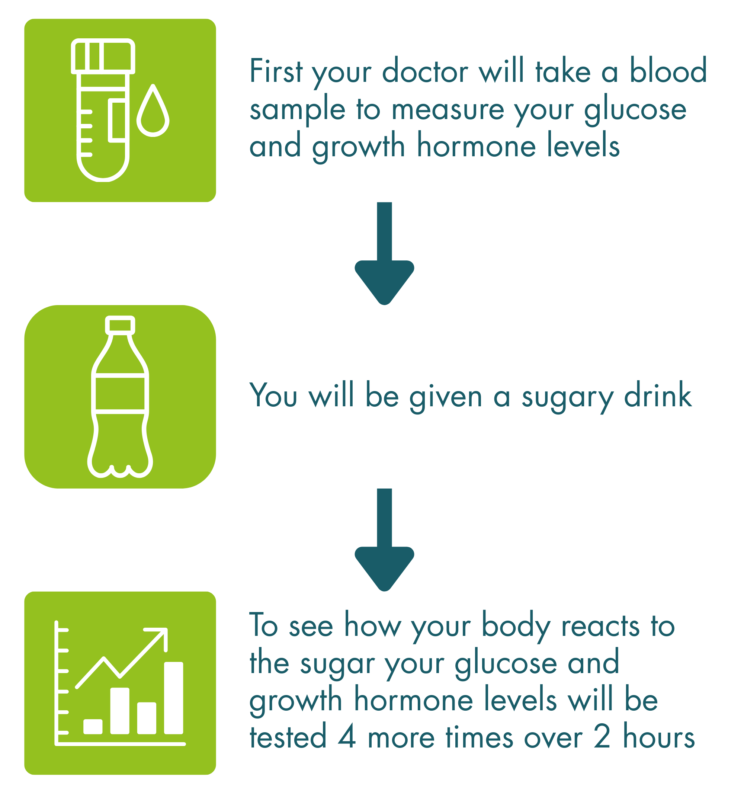
Because natural levels of growth hormone change so much during the day, a one-off blood test cannot be used alone to diagnose acromegaly, and your doctor will refer you for something called an oral glucose tolerance test.
Growth hormone affects not only the growth of your body, but also how it uses energy. This means that the amount of glucose (sugar) in your blood is related to how much growth hormone your pituitary gland is producing.2 In a person without acromegaly, lots of glucose in the blood stops the release of growth hormone, and levels go down. If you have acromegaly, when you have lots of glucose in your blood your body will continue to produce growth hormone, and your levels will stay high.1
How the test is done3
Measuring IGF-1
Growth hormone tells your liver to make IGF-1, which is essential for a range of things, including muscle growth and maintaining a healthy heart, kidneys and immune system.4 When IGF-1 levels are high, it tells the body to stop producing growth hormone, which in turn reduces the IGF-1 production. If the body is not responding and continues producing growth hormone, then IGF-1 levels will also be high.5
As IGF-1 levels are more constant throughout the day than growth hormone, your doctor can measure them with a single blood test. If your IGF-1 levels are high, it could indicate you have acromegaly.6
References
- Mayo Clinic. Acromegaly. Available at: https://www.mayoclinic.org/diseases-conditions/acromegaly/diagnosis-treatment/drc-20351226. Last accessed April 2025.
- Cleveland Clinic. Human Growth Hormone (HGH). Available at: https://my.clevelandclinic.org/health/articles/23309-human-growth-hormone-hgh. Last accessed April 2025.
- NHS Kings College Hospital. Available at: https://www.kch.nhs.uk/wp-content/uploads/2023/01/pl-930.1-oral-glucose-tolerance-test-for-growth-hormone.pdf. Last accessed April 2025.
- Puche, JE and Castilla-Cortázar, I. J. Human conditions of insulin-like growth factor-1 (IGF-1) deficiency. Translational Med. 2012;10:224.
- Janssen JAMJL. Mechanisms of putative IGF-I receptor resistance in active acromegaly. Growth Horm IGF Res. 2020;52:101319.
- MedlinePlus. IGF-1 (Insulin-like Growth Factor 1) Test. Available at: https://medlineplus.gov/lab-tests/igf-1-insulin-like-growth-factor-1-test/. Last accessed April 2025.