


Day-to-day life
Having a clear plan is fundamental to navigating life with asthma. Action plans are a written list of tasks, which, if adhered to, can minimise the impact asthma has on your day-to-day life.
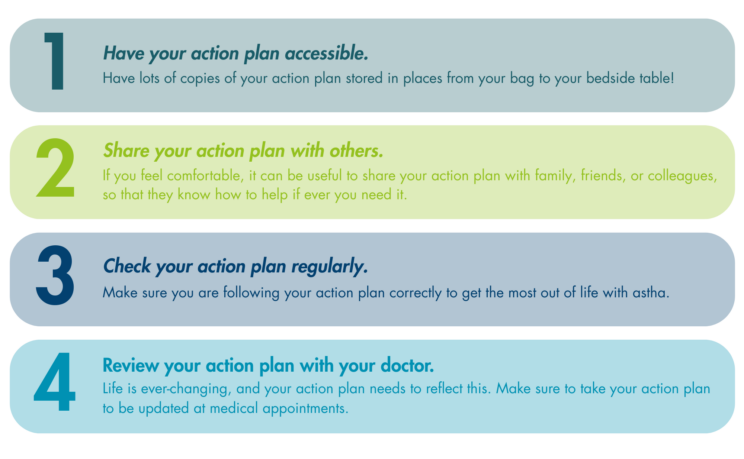
Usually, you will work with your doctor to create an action plan together. The tasks on your action plan will vary, from planning your treatment to avoiding triggers.
![three boxes providing examples of types of action plan, with blank spaces that would be filled out by a person with asthma. First is an every day plan: “Avoiding my asthma triggers, these include [blank space]. When and how often to use my prevention inhaler [blank space]. Other medicines or devices I should be using daily [blank space]. Other medicines or devices I should be using daily [blank space]. How often to take a peak flow measurement [blank space]. When I will exercise [blank space].” Second is a symptomatic plan: “How often to use my reliever inhaler until I feel better [blank space]. How much to increase my preventer inhaler use by [blank space]. Have my reliever inhaler accessible at all times. Note what symptoms I have experienced [blank space]. Call a doctor if [blank space].” Third is an emergency plan: “Sit up straight and try to remain calm. Take one puff of your relieve inhaler every 30-60 seconds up to 10 puffs. If you feel worse OR don’t feel better after 10 puffs call 999. Repeat all steps until you receive medical assistance.This advice does not apply to you if you use a MART inhaler.”](https://www.advanzpharmaforpatients.com/uploads/images/_diseaseInfographic/Asthma-11.png)
Image adapted from ‘Your asthma action plan – Asthma + Lung UK’ 1
An action plan won’t look the same for everyone, as we all have different asthma triggers, as well as different routines and interests to account for. Explore the different elements of day-to-day life to see how your action plan may be adjusted for each.
All these tasks can feel like a lot to remember; to help, Asthma + Lung UK provide action plans that can be downloaded or printed, to have accessible at any time.1
Exercising
You may have thought that asthma would limit your ability to exercise, but exercising can actually help keep asthma symptoms under control. There are several ways to avoid triggers when exercising, to make taking part in the sports you enjoy easier.
- Exercise regularly to strengthen the heart and lungs, which will reduce some symptoms of asthma. You can also avoid triggers such as cold air by wearing a face mask, breathing through your nose, or exercising indoors.2
- Maintain a healthy weight to prevent inflammation in the lungs that would be in addition to that caused by asthma.2
- Speak to a doctor to manage acid reflux and heartburn, if experienced whilst exercising, as these conditions may irritate the airways and worsen asthma.2
If you are still finding it hard to exercise, speak to your doctor. This is likely a sign that your treatment is not sufficient to manage your asthma and requires review.2


Travelling
Asthma shouldn’t stop you from travelling abroad. However, it does mean there are a few actions you may need to take in preparation for your trip.
- Visit the doctor before your trip. Your doctor can make sure your action plan is up to date, provide you with a medical record in case you need care whilst away, and advise what to do in the event of an acute asthma attack.3
- Make sure you have enough medicine easily accessible for the duration of your trip.3
- Consider the triggers you may encounter in your travel and accommodation arrangements and try to keep these to a minimum. This may involve forewarning your host about triggers such as dust, animals, and allergens.
It’s also a good idea to make sure you are covered by appropriate travel insurance. Not all insurance companies will cover people with pre-existing conditions, so you might want to shop around and ask questions to make sure you are covered properly.
Work and study
You are still able to work and study if the right procedures to manage at school or in the workplace form part of your action plan.
These procedures include:
- Making the school/workplace aware of your diagnosis and the time off you may need for medical appointments.
- Explaining to the school/workplace how to accommodate you best. This includes adjusting your responsibilities to minimise exposure to triggers, such as dust or cold air, and having emergency procedures in place.2
- Considering your workload and the potential to alter your working hours.
If you believe your asthma may be triggered by exposures in the workplace, it is important that you explain this to your doctor, so that you can find a productive solution that doesn’t put your health at risk.2

References
- Your asthma action plan – Asthma + Lung UK. Available at: https://www.asthmaandlung.org.uk/conditions/asthma/manage/your-asthma-action-plan. Last accessed April 2025.
- Living with asthma – NHS. Available at: https://www.nhs.uk/conditions/asthma/living-with/. Last accessed April 2025.
- Travelling safely with a lung condition – Asthma + Lung UK. Available at: https://www.asthmaandlung.org.uk/living-with/travel/safely. Last accessed July 2025.