


Medications
The right medications for you depend on a number of factors.
These factors include:1
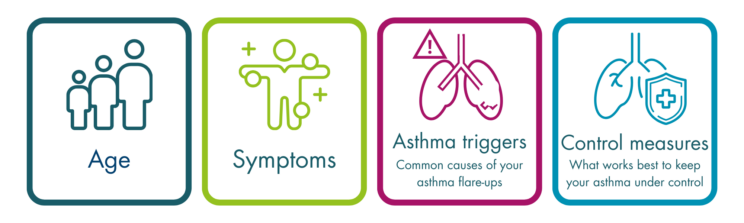
Treatment suggestions can be driven by the symptoms you have. For example, different drug and dose recommendations may be provided depending on how often you have symptoms, whether you wake up with symptoms, and generally how uncontrolled your asthma is.2
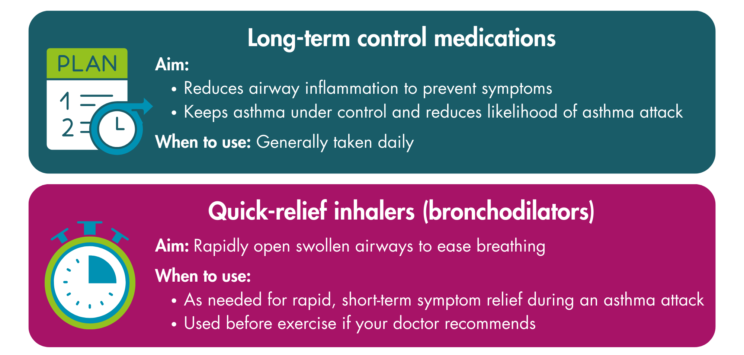
Asthma medications fall into two main categories – long-term control mechanisms and quick-relief inhalers (bronchodilators).1
In some cases, allergy medications may also be needed alongside quick-relief inhalers.
Within each of these two categories, there are multiple different types of medications that your doctor may recommend. Types of long-term control medications include:
- Inhaled corticosteroids provide the most effective long-term control with minimal risk of serious side effects.
- Leukotriene modifiers help manage symptoms but may cause psychological side effects in rare cases.
- Combination inhalers contain both a corticosteroid and a long-acting bronchodilator for better symptom control.
- Oral medication that relaxes airway muscles but requires regular monitoring due to potential side effects.1

While effective in some adults with severe asthma, oral corticosteroids are often associated with substantial side effects. For this reason, they should only be considered for adults with poor symptom control and/or frequent exacerbations despite having good inhaler technique and following treatment recommendations.2
Types of quick-relief medications include:
- Short-acting beta agonists quickly open airways and can be taken via inhaler or nebuliser.
- Anticholinergic agents help relax airways, mainly used for severe cases.
- Oral and intravenous corticosteroids reduce inflammation during severe asthma attacks but are not for long-term use due to side effects.1
If your long-term control medications are working properly, you shouldn't need to use your quick-relief inhaler very often. However, it’s important to have it available in case of an asthma flare-up or asthma attack.
Keep a record of how many puffs you use each week. If you need to use your quick-relief inhaler more often than your doctor recommends, see your doctor as you will likely need to adjust your long-term control medication.
Biologics and biosimilars
Biologic medicines refer to medicines made from a living source, such as cells or tissues. “Biosimilars” is another term that may be used when talking about biologics. Biosimilars are biological medicines which are highly similar to the original biologic reference medicine in terms of quality, safety and efficacy. This means there is no clinically meaningful difference between the biosimilar and the original biologic medicine.
Biologics help to control asthma by blocking specific cells or molecules in your body that would cause your airways to swell (inflammation).3 They are usually used in people who have moderate-to-severe asthma4 whose symptoms are not well controlled by the medications mentioned on this page above.
A personalised approach
Everyone’s asthma is different. Different molecules and cells in the immune system are responsible for causing the symptoms of asthma in different people. This means that biologics should be matched to your specific asthma.4
Your doctor may mention the term “biomarker” when describing how to assess whether your asthma is suitable for a particular type of biologic. A biomarker is something that can be tested for in your body, which provides information about which cells or molecules are involved in your asthma. Your doctor will be able to review this information and discuss with you whether a biologic treatment may be suitable for your asthma.
How are they taken?
Biologics are given by injection, which is usually done by your doctor or nurse.
References
- Mayo Clinic. Asthma. Available at: https://www.mayoclinic.org/diseases-conditions/asthma/diagnosis-treatment/drc-20369660. Last accessed April 2025.
- Global Initiative for Asthma (GINA). Global Strategy for Asthma Management and Prevention (2024). Available from: https://ginasthma.org/wp-content/uploads/2024/05/GINA-2024-Strategy-Report-24_05_22_WMS.pdf. Last accessed April 2025.
- McGregor, M.C, et al. Role of biologics in asthma. American Journal of Respiratory and Critical Care Medicine. 2019. Feb;199(4):433–445.
- Asthma and Allergy Foundation of America. Biologics for the Treatment of Asthma. Available at: https://aafa.org/asthma/asthma-treatment/biologics-asthma-treatment/. Last accessed April 2025.